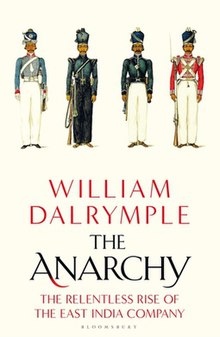
Did you know the word loot only entered the English dictionary in the 18th and 19th centuries? The word originated in India and was commonly used to describe the actions of armies before, during and after bloody conflicts. It entered the English language following the complete chaos and anarchy that was late eighteenth century India, as warring states and the East India Company fought for control of the vast subcontinent.
This chaos is the focus of William Dalrymple’s book The Anarchy and boy does he get to the heart of the matter. Starting off with how the Company came to be, Dalrmyple explores how the English-as they were then-simply wanted an opportunity to grasp some of the potential riches available in the lucrative Indian trade. He shows how for the first century of its existence, the Company barely managed to break even, and how the English and later British were viewed as little more than ants. The Great Mughals had more pressing concerns than simple pirates and traders from a distant land after all.
Indeed, the clearest example of this is during Child’s War, when the East India Company attempted to take advantage of the Mughal Emperor’s wars in the south. They quickly found themselves outmanned and outgunned and forced into a humiliating situation that involved begging.
Of course, as the story moves on, venturing first to Plassey and then onto Buxar and beyond, Dalrymple highlights how the growth of the Company coincided with the decline of the Mughals. As Delhi became little more than a ruin, its former Empire started breaking away into statelets that all competed for power. Into this breach, the Company stepped in. At first unwillingly. The directors in London were horrified when they learned of Clive’s coup against the Nawab of Bengal. But as the riches of India became apparent, they became more willing.
After Bengal, the Company made use of its vast financial and political resources-several hundred MPs had stock in the company-to expand rapidly throughout India. From being a mere trading company to the rulers of a continent spanning empire. The company used their financial might to buy an army that was at times twice or even thrice as big as what the British state had.
They also used their financial resources to bribe and cajole Princes into siding with them, convincing them that this was in their own interest. After doing this, the Company extracted vast amounts of wealth from India, looting it into oblivion. Causing a famine in Bengal in 1770 and drought and chaos elsewhere.
Such was their exploitation that debates were held over the way the company acted and was run. Clive committed suicide due to unrelated reasons and avoided being held to account properly. But Warren Hastings, his successor as Governor-General was put on trial. He was cleared, but never worked properly again. Hastings was the only one of a long line of Governor-Generals who actually bothered to learn more about India and its culture. His successors did not bother.
Of course, whilst Dalrymple’s main focus is on the rise of the Company, he also spends time covering the Princes and the last true Mughal Emperor Shah Alam. By doing so, he paints a somewhat sad and frustrating picture.
Shah Alam was a man who perhaps in another age would be remembered as the great poet he was, but instead, he is remembered as the man who truly lost the Empire. Beset by internal divisions and external hardships, the only time he ever truly cracked was in 1788 when his former protege Ghulam Qadir turned against him.
As for the other Princes, Tipu Sultan, Hyder Ali, Mir Qasim, Mir Jafar and the Marathas, there were several times during the book where I wanted to scream. Had they only worked together they could have destroyed the Company, as at Pollilur in 1781, or at Plassey in 1757, or Buxar in 1764 or even at Assaye in 1803. But their own petty disputes allowed them to be divided by the Company and a chance of a free India died with them.
In The Anarchy Dalrymple does a fantastic job showing how the Company rose to power and leaves the reader wondering what if?
 Vivek Rajkhowa
Leave a comment