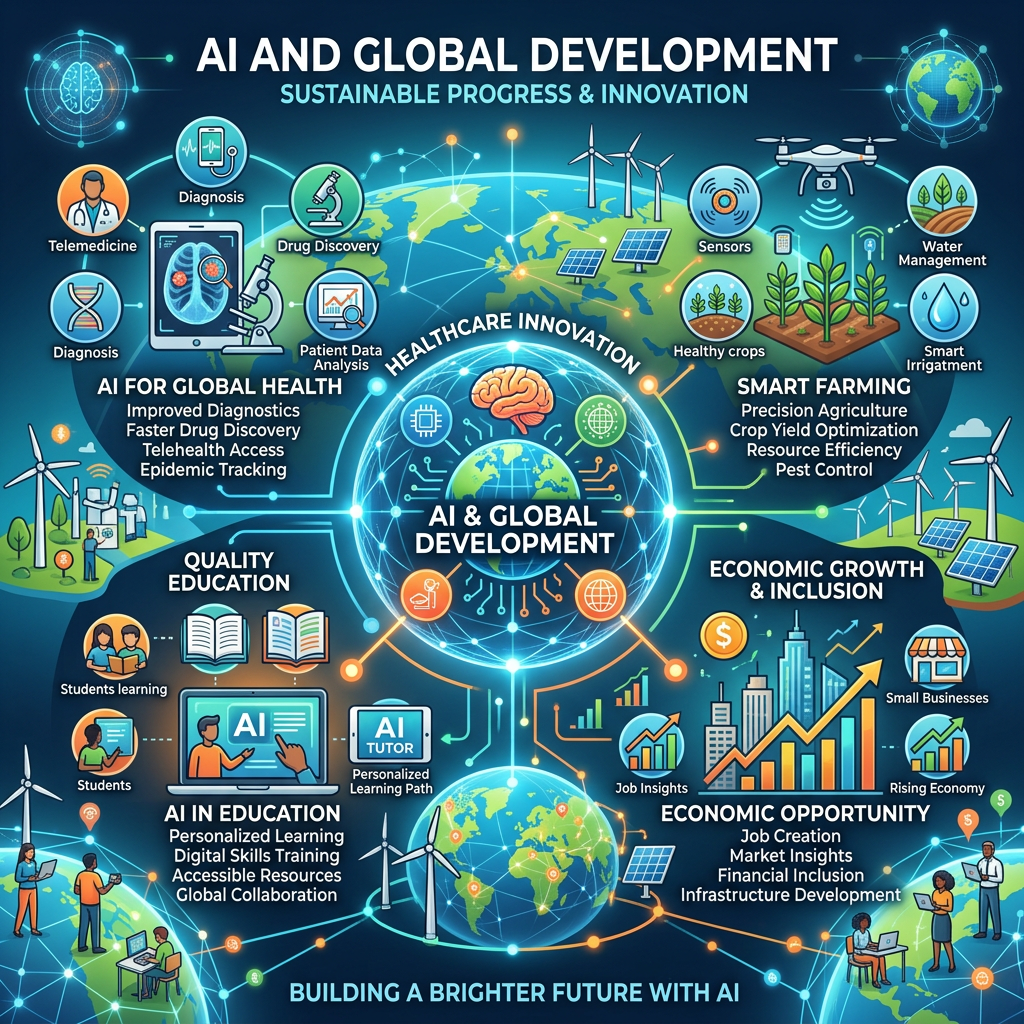
No longer a futuristic concept, AI is currently reshaping the global landscape, as the UN and the IMF observe, AI possesses the dual capacity to be a monumental engine for human progress as well as a primary driver of global inequality. While the potential for a large boost in global GDP over the next decade is within reach, the distribution of these gains remains dangerously lopsided.
A Force For Good
The UN has highlighted how AI could help accelerate the achievement of 80% of the Sustainable Development Goals (SDG). How can AI do this? Through enhancing traditional human capabilities, AI-driven technologies are providing solutions to some of the world’s most persistent challenges, including:
- Healthcare (SDG 3): Predictive analytics and diagnostics are improving patient outcomes.
- Agriculture (SDGs 2 & 15): Satellite imagery and drones identify crop diseases in places like Cameroon and Cabo Verde, bolstering climate resilience.
- Education (SDG 4): Personalised learning tools are being deployed to bridge literacy gaps.
- Humanitarian Response: Tools like the WFP’s Hunger Map LIVE track food insecurity in over 90 countries, while UNHCR’s Project Jetson uses predictive modeling to forecast refugee movements.
The Economic Divergence
Despite these successes, the IMF warns of a growing AI gap. Advanced Economies such as the USA and China are positioned to benefit disproportionately due to superior infrastructure, data access and AI preparedness.
Modelling done by the IMF suggests that the growth impact in Advanced Economies could be more than double that of Low-Income Countries, creating a macroeconomic paradox: whilst AI increases productivity in tradable sectors, it also significantly boosts non-tradable sectors like healthcare and education. Such a shift has the potential to lower prices in Advanced Economies leading to moderate currency depreciation that makes their exports more competitive, further distancing them from developing nations.
The Shadows of Artificial Intelligence
UN Secretary-General Antonio Guterres has emphasised that “humanity’s fate cannot be left to an algorithm.” Beyond economic disparity, several shadows threaten global stability, these include:
- Information Integrity: AI-powered disinformation hampers over 70% of UN peacekeepers’ efforts and threatens to derail climate action.
- Human Rights: The rise of generative AI has led to an increase in nonconsensual pornographic imagery and harmful content targeting marginalised groups.
- Democracy: The potential for AI to manipulate public opinion during elections poses a systemic threat to democratic processes.
- Labour Markets: The International Labour Organization (ILO) notes that while AI drives productivity, it risks exacerbating inequality if workers in developing nations lack the skills to adapt.
The Path to Inclusive Governance
To ensure that AI serves all of humanity rather than a powerful few, the international community has begun to move toward a framework of Digital Cooperation.
The Global Digital Compact, adopted in September 2024 serves as a roadmap for this transition. Central to this effort is the Independent International Scientific Panel on AI, a body of 40 experts tasked with assessing AI’s societal impacts. Additionally, the UN’s high-level advisory body on AI has proposed several recommendations to bridge the governance gap, primarily focusing on aligning AI with international law and human rights.
Conclusion
Finally, the IMF suggests that closing the AI gap is not just a moral imperative but a win-win for the global economy. Through improving the access to data and high-level infrastructure in Emerging Markets and Low Income Countries, the world can achieve higher overall growth with positive spillbacks to advanced nations.
However, to achieve this, the world needs more than just technological transfer. It requires inclusive governance. We must lay the foundations for an architecture where AI development prioritises people over profit, ensuring that AI innovation reaches the most vulnerable populations before the shadows of inequality become permanent.


Leave a Reply