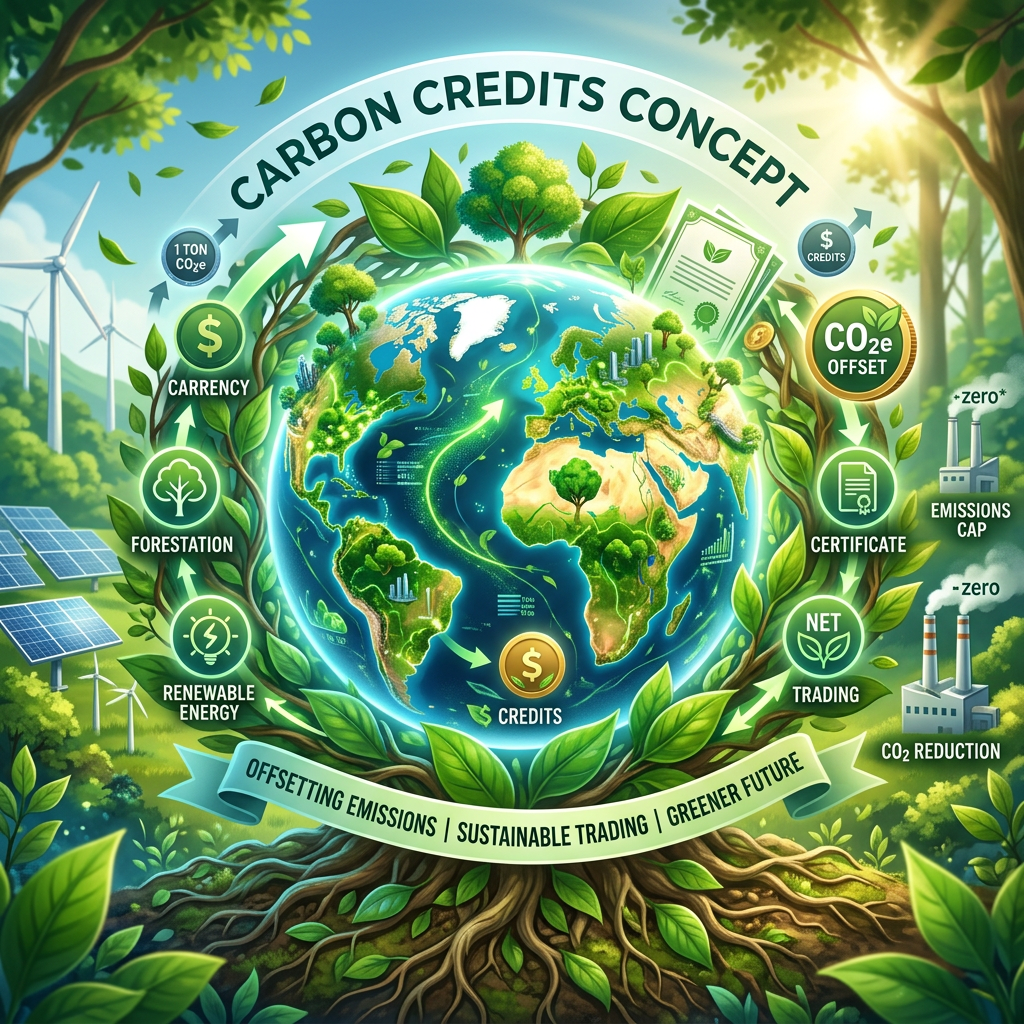
The current global climate landscape has left carbon as persona non grata. The drive toward Net Zero has shifted from a voluntary goal to a global imperative. However, for many developing nations, the path to decarbonisation is complex, as industrial growth often remains tied to traditional energy sources. To bridge this gap, carbon credits have emerged as a vital mechanism for balancing economic progress with environmental stewardship,
What are Carbon Credits?
A carbon credit is a tradable certificate representing the reduction, avoidance, or removal of one metric tonne of carbon dioxide (or an equivalent amount of other greenhouse gases) from the atmosphere. These credits act as a market-based tool, allowing entities—be they corporations or countries—to “offset” their emissions by funding projects that actively improve the planet’s carbon balance.
Essentially, carbon credits turn emission reductions into a financial asset. They are generated by verified projects such as afforestation, soil carbon sequestration, or high-tech solutions like Direct Air Capture (DAC). By purchasing these credits, an organisation can compensate for unavoidable emissions, effectively neutralizing their carbon footprint.
The Two Pillars of Carbon Credits
Currently, the market is divided into two primary categories:
- Nature-Based Solutions: These leverage natural processes like photosynthesis to capture carbon. Key examples include reforestation, the restoration of peatlands, and “blue carbon” projects that protect coastal mangrove ecosystems, which are incredibly efficient at storing CO2.
- Technology-Based Solutions: These involve engineered processes to remove or prevent emissions. This includes Direct Air Capture (DAC), which pulls CO2 straight from the sky; Biochar, where biomass is converted into stable charcoal and buried; and Mineralisation, which chemically transforms CO2 into solid rock.
Why Developing Countries are Leading the Charge
For developing nations, carbon credits are far more than just a “workaround”; they represent a critical intersection of finance and sustainability.
- Capital Inflow for Green Infrastructure: Developing countries often possess vast natural resources—such as tropical rainforests—but lack the liquid capital to transition to renewable energy. Carbon markets allow these nations to monetise their natural assets, bringing in foreign investment that can fund solar grids, wind farms, and sustainable agriculture.
- Socio-Economic Co-benefits: Carbon projects rarely exist in a vacuum. A project focused on restoring mangroves doesn’t just capture carbon; it also protects coastlines from storm surges, restores local fisheries, and creates jobs for coastal communities.
- Incentivising Conservation over Extraction: In many regions, the economic pressure to clear land for timber or cattle is high. Carbon credits provide an alternative revenue stream, making a standing forest more valuable than a cleared one.
- Technology Transfer: Engagement in carbon markets often facilitates the transfer of advanced monitoring and green technologies from developed nations, helping developing economies “leapfrog” the carbon-intensive stages of industrialization.
Conclusion
Carbon credits represent a pragmatic marriage between environmental necessity and economic reality. By placing a tangible value on the air we breathe and the forests we protect, they provide a framework where developing nations can thrive without repeating the high-emission mistakes of the past.
As these markets mature and transparency improves, carbon credits will likely evolve from a secondary tool into the backbone of a global “green economy.” Ultimately, they offer a path where the pursuit of prosperity no longer requires the sacrifice of the planet, ensuring that the march toward Net Zero is an inclusive, global effort.


Leave a Reply