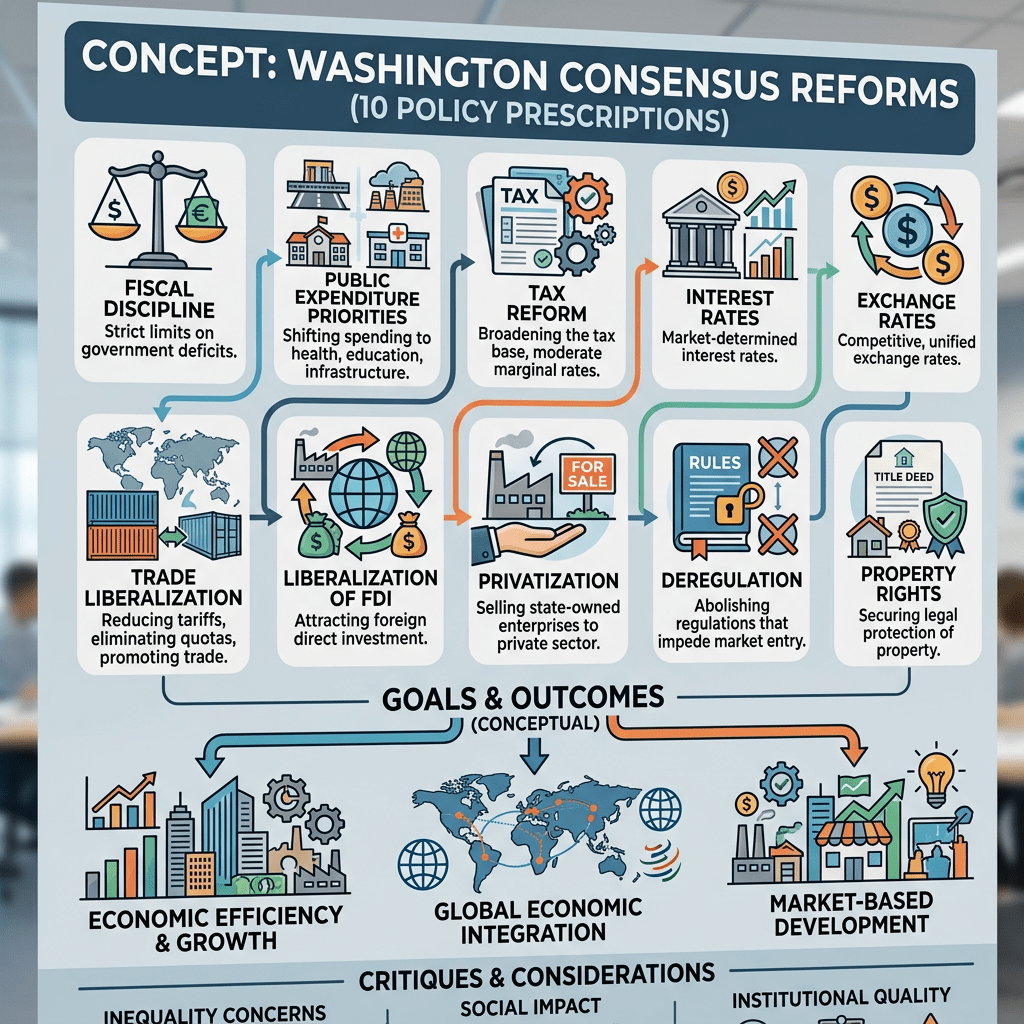
Coined in 1989 by the economist John Williamson, the term “Washington Consensus” originally described a specific list of ten economic policy recommendations aimed at reviving Latin American economies. During the early to mid-1980s, the region was severely battered by macroeconomic turbulence, hyperinflation, and a crushing debt crisis. Williamson used the phrase descriptively to outline a growing agreement among Washington-based institutions—chiefly the International Monetary Fund (IMF), the World Bank, and the U.S. Department of the Treasury—regarding the necessary prescriptions for recovery. As time moved on however, the term grew beyond the original intent, moving into a global shorthand for neoliberalism and market-led development.
The Road to the Consensus
With the emergence of the Washington Consensus, development economics experienced a profound shift. In the immediate aftermath of World War 2, the global South had embraced state-dominated economic systems, relying on subsidies, overvalued exchange rates and protectionist trade barriers to shield their domestic industries. However, by the 1980s, these policies had triggered rampant economic distortions, inefficient state-owned enterprises, and massive national budget deficits.
When the debt crisis struck, major Western powers, spearheaded by the United States, positioned the IMF and the World Bank to manage global development policy and debt stabilisation. These institutions tied much-needed loans to strict policy requirements known as stabilisation and structural adjustment programs. The consensus rested on two foundational neoliberal pillars: fostering intense domestic and international competition through deregulation and trade opening, and drastically shrinking the footprint of the state through privatisation and fiscal discipline.
The Ten Core Reforms
Williamson’s framework compiled ten distinct policy reforms that he argued virtually everyone in Washington agreed were necessary:
- Fiscal Discipline: Curbing large budget deficits to control inflation and reduce the need for government borrowing.
- Public Expenditure Redirection: Shifting government spending away from politically motivated subsidies toward high-return fields like basic healthcare, education, and infrastructure.
- Tax Reform: Broadening the tax base and removing exemptions to improve collection and efficiency.
- Financial Liberalisation: Allowing market forces to determine interest rates rather than political rationing.
- Competitive Exchange Rates: Adopting market-driven, single exchange rates to boost export-led growth.
- Trade Liberalisation: Reducing tariffs and abolishing quotas to integrate into the global economy.
- Foreign Direct Investment (FDI): Eliminating barriers to inward foreign investment to bring in capital, technology, and skills.
- Privatisation: Selling off inefficient state-owned enterprises that widened fiscal deficits.
- Deregulation: Abolishing regulations that restricted market entry and stifled competition.
- Property Rights: Securing legal property rights to incentivize individual investment and expand the tax base.
Evolution and Criticism
By the 1990s, the Washington Consensus took on a life of its own, becoming synonymous with rigid, free-market orthodoxy. While proponents pointed out that trade openness and FDI rescued millions from poverty and increased productivity, critics increasingly viewed the consensus as a dogmatic, top-down policy package that imposed severe economic pain and hardship without guaranteeing growth.
By the late 1990s, the mixed success of these reforms led to the “post-Washington Consensus,” shifting institutional focus toward poverty reduction and institutional health. Recent economic analysis presents a nuanced view: while fundamental policies like fiscal prudence and using market prices remain vital for preventing economic collapse, unmitigated financial openness—especially short-term capital flows—and premature fiscal consolidation can inflict high welfare and employment costs. Nonetheless, the core debate endures, balancing the proven benefits of market mechanisms against the necessity of social safety nets.


Leave a Reply