For decades, the field of development economics has been defined by an ideological pendulum swing. In the immediate post-World War II era, structuralism dominated, advocating for massive state intervention and import-substitution to build heavy, capital-intensive industries. After these policies led to inefficiency and stagnation, the pendulum swung violently to neoliberalism and the Washington Consensus of the 1980s and 1990s. This framework pushed for rapid privatisation, deregulation and shock therapy marketisation, which precipitated economic collapse and a lost decade for most of the developing world.
Recognising the stark limitations of both approaches, Justin Yifu Lin pioneered New Structural Economics (NSE). Formally introduced during his tenure as Chief Economist of the World Bank, NSE offers a third-generation development paradigm. It applies a rigorous neoclassical approach to study the determinants and evolution of a nation’s economic structure, bridging the gap between state guidance and market freedom.
What is New Structural Economics?
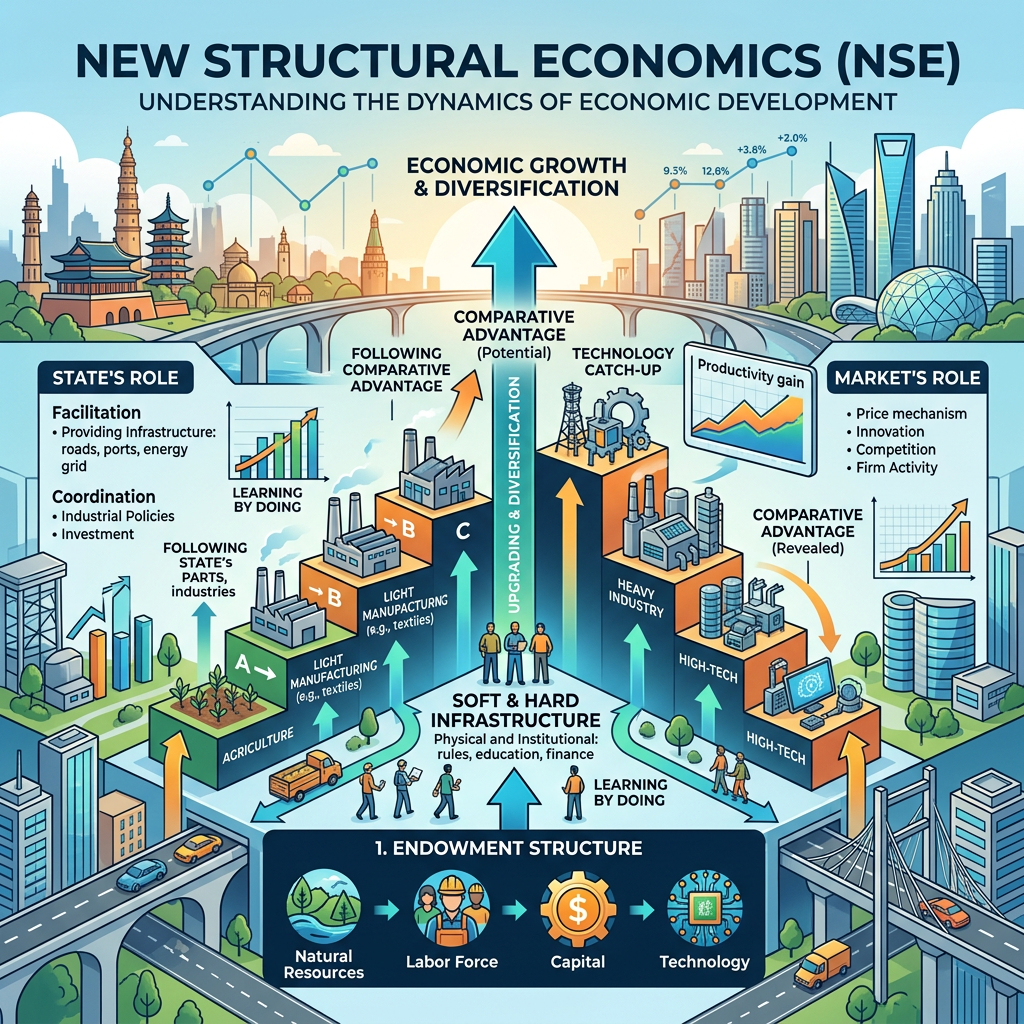
At its fundamental level, NSE posits that a country’s economic structure is tied to its factor endowments—the relative abundance of land, labour and capital at any given point in time. Rather than artificially forcing the development of advanced, capital-intensive industries from day one, a developing nation should organically grow through aligning its industrial structure with its current comparative advantages.
The mechanism of NSE operates as a collaborative duality:
- An Efficient Market: The market acts as the fundamental resource allocator. A well-functioning price mechanism is necessary to reflect the true scarcity of factor endowments, signaling to entrepreneurs which industries are inherently viable and profitable.
- A Facilitating Government: Market forces alone cannot seamlessly transition a country from low-to-high income. Industrial upgrading requires parallel improvements in hard infrastructure (highways, grids, ports) and soft infrastructure (legal systems, financial regulations). Because individual entrepreneurs cannot internalise the costs of these systemic public goods, a proactive state is vital to overcome structural bottlenecks.
In short, NSE shifts the focus from fixing market failures (structuralism) or eliminating state intervention (neoliberalism) to leveraging state capability to foster industrial competitiveness.
How NSE is Viewed in the Development Sphere
Within the global development community, NSE has sparked both profound interest and intense debate, carving out a distinct position among economists and policymakers.
1. Real-World Validation
Proponents of NSE point to its strong alignment with empirical history. The East Asian Tigers (South Korea, Taiwan, Singapore, and Hong Kong), and subsequently China and Vietnam, did not follow Western neoliberal orthodoxy. Instead of shock therapy, they adopted gradualist, pragmatic, and piecemeal transitions. They started with labour-intensive industries matching their initial endowments, using export promotion rather than import substitution, and gradually scaled up the value chain as capital accumulated. NSE provides the theoretical blueprint for why this historical anomaly worked.
2. The Critique of Industrial Policy
Despite its real-world parallels, NSE faces skepticism from conventional neoliberal and neoclassical economists. The primary critique centers on the state’s capacity to deploy selective industrial policies without falling prey to corruption or rent-seeking. Critics argue that “picking winners” risks misallocating capital, and that governments are prone to institutional failures that can be more damaging than the market failures they aim to correct.
3. Integration into Modern Governance
Despite the skepticism, NSE has heavily influenced the contemporary development sphere by moving the conversation past the rigid “state vs. market” dichotomy. It is increasingly viewed as a highly practical framework for escaping both the low-income and middle-income traps. By treating the state as an active, organic participant in economic evolution—rather than an outside regulator or an overarching central planner—NSE provides a realistic toolkit for developing nations striving to convert their latent comparative advantages into enduring global competitive advantages.


Leave a comment