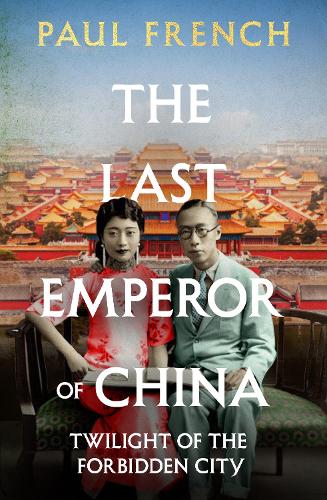
Paul French’s The Last Emperor of China: Twilight of the Forbidden City is a fascinating and surprisingly intimate portrait of the final members of China’s imperial family. While Puyi is often remembered primarily through the lens of his later life — as the last emperor of China and later the puppet ruler of Manchukuo — French takes a different approach, focusing on the strange, tragic and deeply human world he inhabited after the fall of the Qing dynasty.
What makes this book so compelling is the way it brings Puyi, Wanrong and Wenxiu to life as people rather than simply historical figures. The collapse of the empire did not mean the end of the imperial household overnight. Instead, Puyi and his family continued living inside the Forbidden City, surrounded by the rituals, servants and traditions of an empire that no longer existed. They were simultaneously treated as royalty and prisoners of a vanished age.
French does an excellent job of capturing the bizarre contradictions of Puyi’s childhood. He was still addressed as emperor, still surrounded by the ceremonies of the Qing court, and still expected to embody centuries of imperial tradition. Yet beyond the palace walls was a modernising China that had rejected the monarchy. Puyi was a boy raised to believe he had a divine destiny, but with no actual power. The book shows how isolating and damaging that experience was, and how difficult it was for him to understand a world that had changed around him.
I particularly appreciated the attention given to Wanrong and Wenxiu. Too often they are treated as little more than figures in Puyi’s story, but French gives them their own personalities and struggles. Wanrong emerges as an intelligent, curious young woman who wanted to experience the wider world but found herself trapped by the expectations placed upon an empress. Her fascination with Western culture and her desire for independence make her a much more sympathetic and interesting figure than the traditional portrayals of her often suggest.
Wenxiu’s story is equally fascinating. Her decision to leave Puyi was a remarkable act of courage, especially given the social expectations of the time. French presents her not simply as someone escaping an unhappy marriage, but as a woman attempting to claim control over her own life in a society where that was extremely difficult.
One of the highlights of the book is the role played by the two Western tutors who entered this closed and mysterious world: Reginald Johnston and Isabel Ingram.
Johnston is a wonderfully colourful character. A Scottish scholar, diplomat and devoted admirer of Chinese culture, he was unlike anyone else in Puyi’s world. Rather than treating him as a sacred symbol, Johnston treated Puyi as a young man who needed education, friendship and intellectual stimulation. He introduced him to Western literature, ideas and technology, helping awaken a curiosity that had been suppressed by the rigid traditions of the court. Unsurprisingly, the Imperial Household Department viewed him with suspicion, as he was gradually encouraging the emperor to think beyond the narrow confines of palace life.
Isabel Ingram played a similar role for Wanrong. An energetic and unconventional American tutor, she helped the young empress discover a world beyond court etiquette and ritual. Through English lessons, Western books and new ideas, Ingram encouraged Wanrong to develop her own personality. To the traditionalists within the palace, this was deeply alarming: the imperial household had survived for centuries by controlling access to the emperor and his family, and these two outsiders were helping them become more independent.
The relationship between Johnston and Puyi, and Ingram and Wanrong, is one of the most enjoyable aspects of the book. They represent the clash between an ancient world built on hierarchy and ritual and a modern world built on individualism and personal choice. In many ways, they were not simply tutors but windows into a world that the imperial family had been deliberately prevented from seeing.
What I enjoyed most about French’s book is that it avoids reducing Puyi to either a victim or a villain. It does not excuse his later actions, but it does help explain how a child raised in an environment of isolation, privilege and manipulation became the man he later became. History often remembers emperors through their reigns, but French reminds us that before Puyi was a political figure, he was a young boy trapped by circumstances beyond his control.
Overall, The Last Emperor of China: Twilight of the Forbidden City is an engaging and sympathetic account of a fascinating moment in history. It is a book about the end of an empire, but more importantly, it is a book about the people left behind after that empire disappeared. French’s greatest achievement is showing that behind the titles of Emperor, Empress and Imperial Consort were real human beings trying to find their place in a rapidly changing world.
Highly recommended for anyone interested in China, monarchy, court life or the personal stories behind great historical transformations.


Leave a comment